Case Study
Autonomous Multi-Rover Search System
Developed sensing and embedded software architecture for a multi-rover autonomous search system, focusing on sensor polling, encoder data handling, and rover state monitoring.
Problem
Autonomous rover systems must reliably integrate multiple sensors with different update rates while maintaining consistent state estimation and stable hardware communication. Designing a command and data handling framework that manages sensor timing, embedded firmware constraints, and real-world hardware testing is critical for reliable autonomous operation.
Role
Command & Data Handling (CDH) EngineerUniversity of Colorado Boulder — Senior Design Project • Fall 2025 – Spring 2026
Embedded firmware development, sensor polling architecture design, encoder data handling, electronics prototyping, and rover state monitoring for an autonomous multi-robot search system.
Tools & Skills
Results
- Developed a dual-rate sensor polling architecture to manage sensors operating at different update frequencies.
- Analyzed sensor refresh limits and identified LiDAR scan rate (~10–15 Hz) as the primary constraint on system-level state updates.
- Implemented firmware logic to read quadrature encoder signals and convert counts into wheel rotation and velocity estimates.
- Structured encoder data outputs to support rover motion estimation and navigation.
- Integrated electrical monitoring sensors (INA260) for real-time current, voltage, and power telemetry.
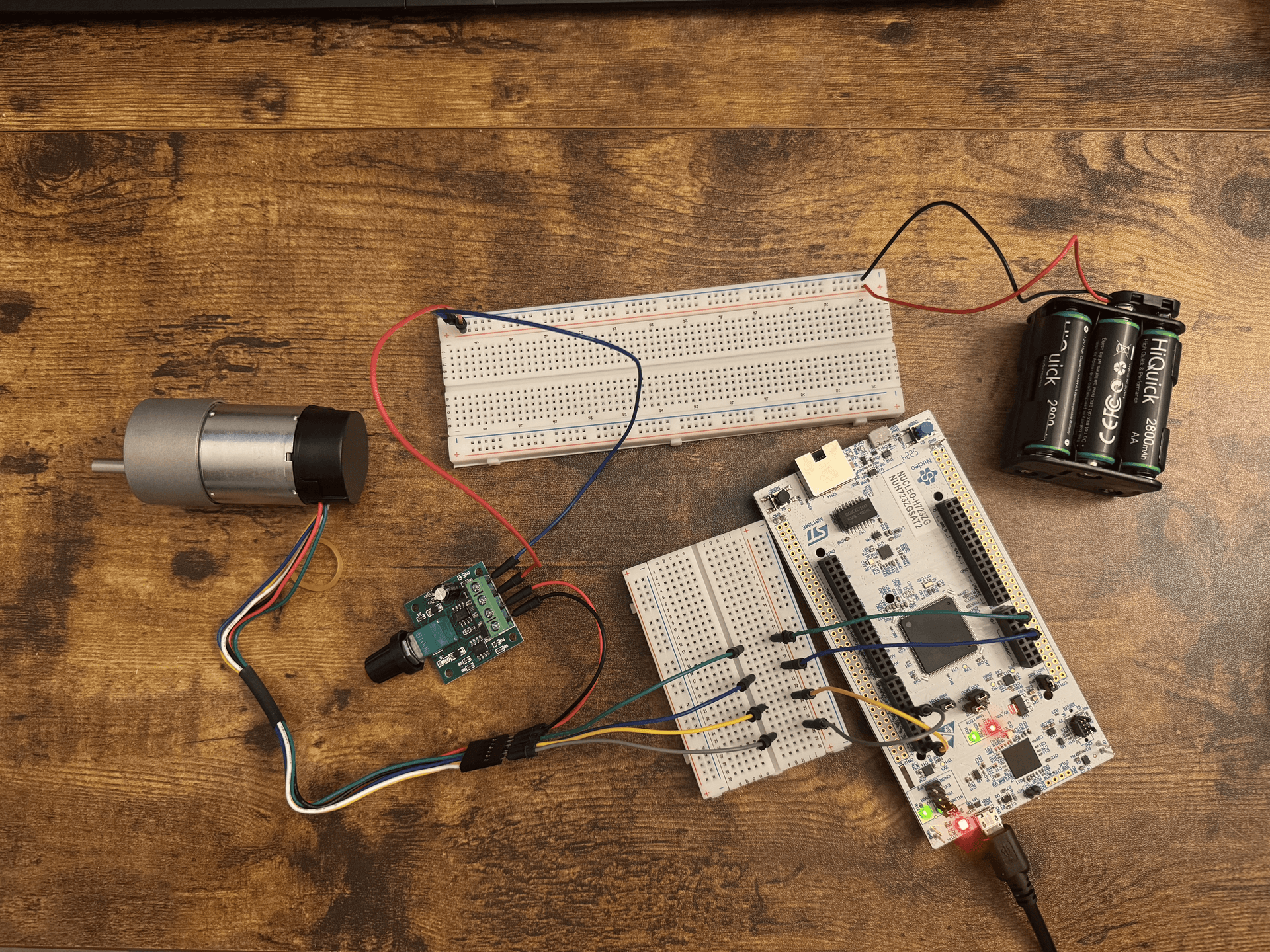
- Built and tested breadboard prototypes to validate sensor connections, encoder signal routing, and microcontroller interfaces.
- Verified sensor outputs through firmware debugging, serial monitoring, and physical testing of encoder signals and power telemetry.
Academic senior design project focused on autonomous robotics architecture and embedded command and data handling.
Build Artifacts